Free Culture
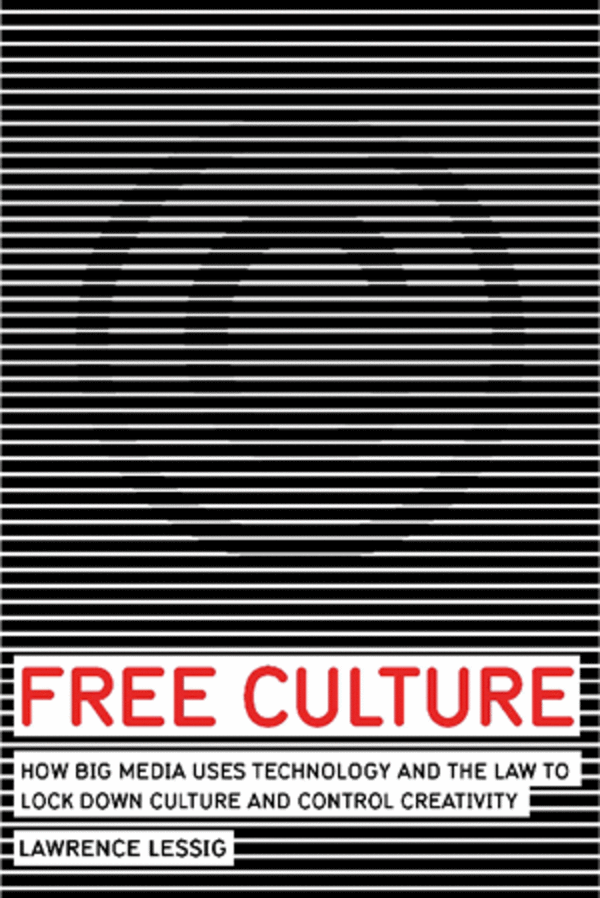
About the Book
Lawrence Lessig could be called a cultural environmentalist. One of America’s most original and influential public intellectuals, his focus is the social dimension of creativity: how creative work builds on the past and how society encourages or inhibits that building with laws and technologies. In his two previous books, CODE and THE FUTURE OF IDEAS, Lessig concentrated on the destruction of much of the original promise of the Internet. Now, in FREE CULTURE, he widens his focus to consider the diminishment of the larger public domain of ideas. In this powerful wake-up call he shows how short-sighted interests blind to the long-term damage they’re inflicting are poisoning the ecosystem that fosters innovation.
All creative works—books, movies, records, software, and so on—are a compromise between what can be imagined and what is possible—technologically and legally. For more than two hundred years, laws in America have sought a balance between rewarding creativity and allowing the borrowing from which new creativity springs. The original term of copyright set by the First Congress in 1790 was 14 years, renewable once. Now it is closer to two hundred. Thomas Jefferson considered protecting the public against overly long monopolies on creative works an essential government role. What did he know that we’ve forgotten?
Lawrence Lessig shows us that while new technologies always lead to new laws, never before have the big cultural monopolists used the fear created by new technologies, specifically the Internet, to shrink the public domain of ideas, even as the same corporations use the same technologies to control more and more what we can and can’t do with culture. As more and more culture becomes digitized, more and more becomes controllable, even as laws are being toughened at the behest of the big media groups. What’s at stake is our freedom—freedom to create, freedom to build, and ultimately, freedom to imagine.
"FREE CULTURE is an entertaining and important look at the past and future of the cold war between the media industry and new technologies."
-- Marc Andreessen, cofounder of Netscape
"The twenty-first century could be the century of unprecedented creativity, but only if we embrace the brilliantly articulated messages in Lawrence Lessig's FREE CULTURE. This book is beautifully written, crisply argued, and deeply provocative. Please read it!"
-- John Seely Brown, coauthor of THE SOCIAL LIFE OF INFORMATION and former Chief Scientist, Xerox PARC
"America needs a national conversation about the way in which so-called 'intellectual property rights' have come to dominate the rights of scholars, researchers, and everyday citizens. A copyright cartel, bidding for absolute control over digital worlds, music, and movies, now has a veto over technological innovation and has halted most contributions to the public domain from which so many have benefited. The patent system has spun out of control, giving enormous power to entrenched interests, and even trademarks are being misused. Lawrence Lessig's latest book is essential reading for anyone who want to join this conversation. He explains how technology and the law are robbing us of the public domain; but for all his educated pessimism, Professor Lessig offers some solutions, too, because he recognizes that technology can be the catalyst for freedom. If you care about the future of innovation, read this book."
-- Dan Gillmor, author of MAKING THE NEWS, an upcoming book on the collision of media and technology
"FREE CULTURE goes beyond illuminating the catastrophe to our culture of increasing regulation to show examples of how we can make a different future. These new-style heroes and examples are rooted in the traditions of the founding fathers in ways that seem obvious after reading this book. Recommended reading to those trying to unravel the shrill hype around 'intellectual property.'"
-- Brewster Kahle, founder of the Internet Archive
Table of Contents
PREFACE | xiii | |||
INTRODUCTION | 1 | |||
“PIRACY” | 15 | |||
| CHAPTER ONE: Creators | 21 | |||
| CHAPTER TWO: “Mere Copyists” | 31 | |||
| CHAPTER THREE: Catalogs | 48 | |||
| CHAPTER FOUR: “Pirates” | 53 | |||
| Film | 53 | |||
| Recorded Music | 55 | |||
| Radio | 58 | |||
| Cable TV | 59 | |||
| CHAPTER FIVE: “Piracy” | 62 | |||
| Piracy I | 63 | |||
| Piracy II | 66 | |||
“PROPERTY” | 81 | |||
| CHAPTER SIX: Founders | 85 | |||
| CHAPTER SEVEN: Recorders | 95 | |||
| CHAPTER EIGHT: Transformers | 100 | |||
| CHAPTER NINE: Collectors | 108 | |||
| CHAPTER TEN: “Property” | 116 | |||
| Why Hollywood Is Right | 124 | |||
| Beginnings | 130 | |||
| Law: Duration | 133 | |||
| Law: Scope | 136 | |||
| Law and Architecture: Reach | 139 | |||
| Architecture and Law: Force | 147 | |||
| Market: Concentration | 161 | |||
| Together | 168 | |||
PUZZLES | 175 | |||
| CHAPTER ELEVEN: Chimera | 177 | |||
| CHAPTER TWELVE: Harms | 183 | |||
| Constraining Creators | 184 | |||
| Constraining Innovators | 188 | |||
| Corrupting Citizens | 199 | |||
BALANCES | 209 | |||
| CHAPTER THIRTEEN: Eldred | 213 | |||
| CHAPTER FOURTEEN: Eldred II | 248 | |||
CONCLUSION | 257 | |||
AFTERWORD | 273 | |||
| Us, Now | 276 | |||
| Rebuilding Freedoms Previously Presumed: Examples | 277 | |||
| Rebuilding Free Culture: One Idea | 282 | |||
| Them, Soon | 287 | |||
| 1. More Formalities | 287 | |||
| Registration and Renewal | 289 | |||
| Marking | 290 | |||
| 2. Shorter Terms | 292 | |||
| 3. Free Use Vs. Fair Use | 294 | |||
| 4. Liberate the Music—Again | 296 | |||
| 5. Fire Lots of Lawyers | 304 | |||
NOTES | 307 | |||
ACKNOWLEDGMENTS | 331 | |||
INDEX | 333 | |||
Links & References
Throughout FREE CULTURE, there are references to links on the World Wide Web. As anyone who has tried to use the Web knows, these links can be highly unstable. This page attempts to remedy the instability. If the original link remains alive, you will be redirected to that link. If the original link has disappeared, you will be redirected to an appropriate reference for the material.
To report a broken link, email [email protected].
Derivatives/Remixes/Free Content
FREE CULTURE is available for free under a Creative Commons license.
You may redistribute, copy, or otherwise reuse/remix this book provided that you do so for non-commercial purposes and credit Professor Lessig.
For the full license, click here.
To make your creative work more easily available to others, click here.
This video (or .ogg) and this video (or .ogg) explain why this is so important.
As does this book:
Click to Download FREE CULTURE (PDF)
(also available in many other formats )
or
| Pre-mixes | Free Culture - The Flash Presentation (or .pdf w/P22 font or audio-only .mp3/.ogg) Free Culture - The Book (.pdf) |
| Translations | Chinese, Catalan, French (PDF, on paper from lulu.com, ePub,MOBI, wiki), Hungarian, Italian, Norwegian (PDF, on paper from lulu.com, ePub, MOBI), Polish, Spanish |
| Audio/Spoken | AKMA, "Free Culture" popup audiobook, Noa Resare (single download) , Pirates (PJ, Groklaw) |
| Audio/Synthesized | Ted Gilchrist |
| Extended Outline | Dan Krimm |
| HTML | ebooks.helptools.net, Hans Schou, Trevor Smith, Elegant Ebooks, NowIs (with improved footnotes) |
| Newton | freeculture.hmkdt.id.au |
| Palm | Sander Claassen, Mark Jordan |
| SiSU (Ralph Amissah) (landscape, portrait), | |
| Plain Text | PC: firasd.org, Paul Schreiber (Canadian Edition) Mac:FreeCulture.txt and FreeCulture.sit (from spiritwritings.com) Linux/Unix: SiSU (Ralph Amissah) |
| Plucker | NowIs (with improved footnotes) |
| PostScript | Alphamonkey.org |
| SGML | Petter Reinholdtsen, Hans Schou |
| Docbook XML | Petter Reinholdtsen |
| Windows CHM | eBooks |